The trajectory of a commercial aviation career is disproportionately influenced by the foundational decisions made during the pre-training phase. Obtaining a Commercial Pilot License (CPL) requires an extraordinary investment of capital, time, and psychological resilience, with total financial outlays routinely ranging from ₹50 lakhs to well over ₹1.5 crores, depending heavily on the chosen geographical pathway, the specific Flying Training Organization (FTO), and subsequent heavy-jet type ratings.
Despite the astronomical stakes inherent in this profession, empirical evidence suggests that a significant percentage of aviation aspirants enter the training ecosystem suffering from profound informational deficits. The selection of an FTO is frequently driven by superficial marketing collateral, anecdotal word-of-mouth recommendations, or a fundamentally incomplete understanding of the global and domestic aviation regulatory frameworks.
In India, the Directorate General of Civil Aviation (DGCA) governs the licensing of flight crew through a complex, dynamically evolving matrix of Civil Aviation Requirements (CARs), exhaustive board verification protocols, and centralized digital tracking portals such as the eGCA system. Navigating this unforgiving matrix without strategic foresight inevitably leads to systemic training delays, severe cost overruns, and in extreme cases, the permanent derailment of a prospective pilot's career.
This report provides an exhaustive, peer-level examination of the top five systemic errors students commit when selecting an FTO. By deconstructing the financial, regulatory, operational, medical, and post-certification paradigms of modern flight training, this analysis offers a sophisticated framework for risk mitigation.
Mistake 1: Failing to Budget Properly and Miscalculating the Total Cost
The most pervasive and financially devastating error committed by prospective students is that they severely underestimate the total cost of training. Aviation training is incredibly capital-intensive. FTOs routinely market their programs using baseline figures that deliberately exclude the volatile, localized, and regulatory costs inherent to prolonged flight operations, leading to catastrophic capital shortfalls. Often, this results in students abandoning their training mere hours before completion due to sudden insolvency.
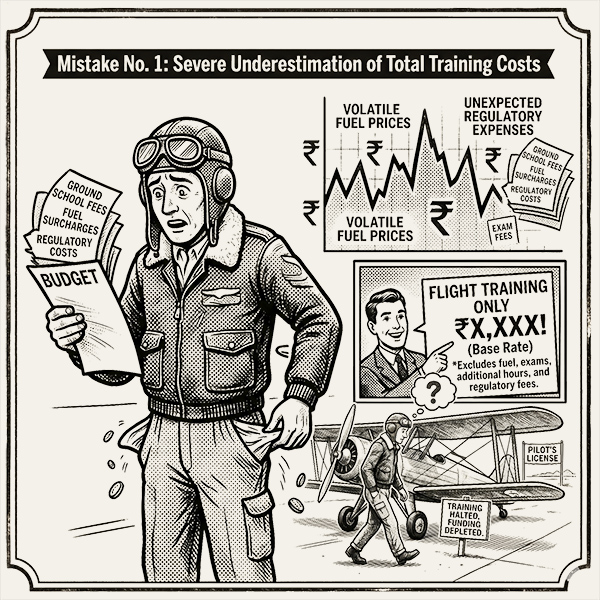
Because not everyone is sponsored, students must adopt a holistic financial architecture that accounts for the entirety of the training lifecycle. Educational financing forms the bedrock of modern pilot training.
| Location / Regulatory Body | Base Cost (INR) | Estimated Hours | Average Timeline | Conversion Hassles |
|---|---|---|---|---|
| India (DGCA) | ₹45L – ₹60L | 200 hrs | 18–24 Mo. | None |
| USA (FAA) | ₹62L – ₹97L | 220–250 hrs | 12–18 Mo. | High (Full RTR) |
| South Africa (SACAA) | ₹35L – ₹47L | 200–250 hrs | 12–16 Mo. | Medium (Part 1 Exempt) |
| Europe / Poland (EASA) | ₹50L – ₹75L | 200–250 hrs | 20–30 Mo. | High (Full RTR) |
| New Zealand (CAA) | ₹68L – ₹72L | 235+ hrs | 18–20 Mo. | Medium (Part 1 Exempt) |
Mistake 2: Underestimating the Regulatory and Documentation Labyrinth
The second critical failure mode occurs when candidates drastically underestimate the uncompromising exactitude of the DGCA's documentation and regulatory compliance infrastructure. The commercial aviation sector operates on the absolute principle of systemic verification; a single typographical error across a decade of educational history can trigger cascading rejections.
Before a student can register for central pilot licensing examinations, they must be allotted a unique DGCA Computer Number. This requires a Board Verification Certificate (BVC). Minor spelling variations across educational documents will result in the immediate rejection of the Computer Number application.
Mistake 3: Overlooking Operational Ratios and Fleet Integrity
A profound misconception among candidates is equating an FTO's marketing presence with its operational capacity. The quality of an FTO is quantified by its aircraft-to-student ratio and the daily serviceability index of its fleet.
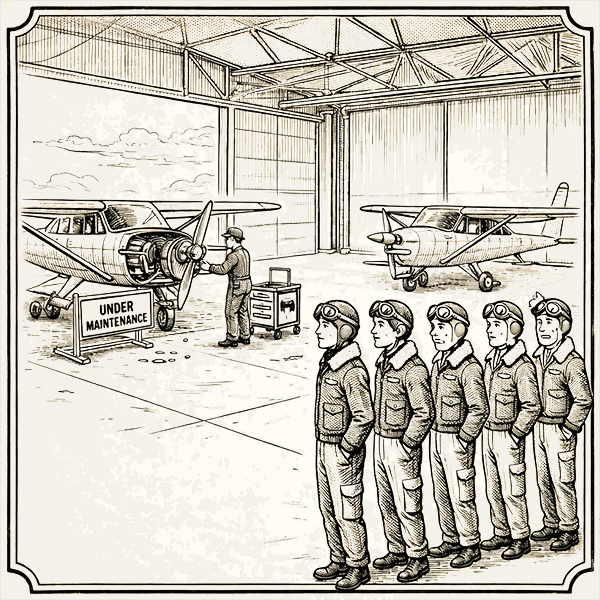
If an academy possesses too few aircraft relative to its cadet population, average monthly flying hours plummet. Aviation training relies heavily on continuous cognitive reinforcement. Extended gaps in a flying schedule erode freshly acquired psychomotor skills, forcing students to burn expensive flight hours merely to relearn basic maneuvers.
Mistake 4: Mismanaging Physiological and Medical Prerequisites
A commercial pilot's license is entirely contingent upon holding an unrestricted DGCA Class 1 Medical Assessment. A startling number of candidates expend lakhs of rupees before undergoing their initial Class 1 medical, only to discover a latent physiological anomaly that permanently disqualifies them.
Mistake 5: Failing to Strategize for Post-CPL Transitions
The final mistake students make is viewing the 200 hours of basic flight training as the entirety of their educational journey. They fundamentally fail to map their trajectory through the post-CPL void, where candidates must navigate supplementary licensing (like the notorious RTR exam), heavy-jet type ratings, and airline cadet selections.
A newly minted CPL holder with 200 hours is legally authorized to fly a light, single-engine piston aircraft. Bridging the immense operational gap to a swept-wing commercial jetliner requires a Type Rating—a highly intensive, simulator-based curriculum.
Conclusion
The evolution of a novice candidate into an airline-ready first officer is an intricate, highly volatile multi-year campaign fought across financial, regulatory, physical, and academic fronts. The modern aviation landscape has fundamentally eliminated the margin for casual error.
To thrive, aspirants must leverage consolidated, professional expertise. By utilizing comprehensive integrators that centralize theoretical instruction, facilitate strategic global FTO placements, and secure robust financial assistance, students effectively neutralize systemic risks and secure their position in the flight deck.
Ready to Earn Your Wings?
Stop guessing and let our experts guide you. From clearing your DGCA medicals to finding the perfect flight school, we provide end-to-end mentorship for the modern Indian aviator.